

In his nomination hearing before the Senate Foreign Relations Committee on Wednesday, January 11, Secretary of State Nominee Rex Tillerson proposed increasing the United States’ involvement in the Saudi-led coalition’s bombing campaign in Yemen, a position that would mark a troubling reversal of the Obama administration’s recent trend of reducing targeting assistance and other support to the coalition.
January 10-17: UN envoy visits Aden, coalition advances in Tihamah
Wednesday, January 11The AP reported heavy fighting between coalition forces and Houthi-Saleh forces near the Bab al-Mandab, with dozens of casualties on both sides.
January 2-9: Government forces clash with AQAP, activist murdered in Taiz
Tuesday, January 3Yemeni pro-government armed forces engaged AQAP fighters in Abyan, reportedly killing 15 and losing 11 of their own.
December 26-January 1: Disagreement over proposed UN peace deal continues into 2017
Monday, December 26 Al Jazeera’s closed bureau in San’a was raided by Houthi forces hours after the network aired a program about the group’s looting of heavy arms. Saeed Thabit, head of Al Jazeera's Yemen office, said in a statement on Facebook that the Houthis stole what was left of office equipment and furniture.
Last Jewish family in Raydah: We wish we could stay, but…
December 19, Raydah - The houses’ gates inscribed with the word “Welcome,” in Hebrew, are the last signs of the Yemeni Jewish community in the town of Raydah, 30 miles north of Yemen’s capital. Near the western edge of Raydah town sits a pair of houses, ordinary in most respects. “The green gate is of Masha, the brown is Banin’s,” said a teen from the neighborhood, identifying the Jewish families to whom the homes once belonged. Now, they’re owned and inhabited by Muslims. As the brown gate squeaked ajar, a little kid peep out, mumbling. Last year nearly a dozen Jewish families from this community left Yemen for Israel in covert airlift described by The Jewish Agency, which arranged the operation, as the last of its kind. Only one Jewish family opted to remain in Raydah. Saʻid al-Naʻati, 55, father of six children and caretaker of his 90-year-old mother, hasn’t yet made up his mind. “It’s my call [whether to emigrate],” said al-Naʻati. “Maybe I’ll travel, maybe I’ll stay.”
Al-Naʻati had his own reasons for opting to stay when he could have left with his neighbors a year ago. But the current situation in Yemen, devastated by two years of war, could soon force his hand. “It has to do with eking out a living. There’s no more living because of the crises and because I no longer have a job,” said al-Naʻati, who used to make jackets out of fur and sell them in the local market. “Now, we have sold half of our belongings [to survive],” he said. The war has rendered millions of Yemenis jobless, and caused rampant inflation. Over one million government employees—upon whose salaries an estimated nine million people depend—have not been paid for four months now. “Everything is expensive and there’s no longer income,” al-Naʻati complains.

Saʻid al-Naʻati outside al- home in Raydah. Photographed by the author.
The emigration of al-Naʻati’s fellow Jews has also made his life harder. “Our hope has been to stay,” al-Naʻati said. “With the extinction of Yemenite Jewry, however, one can’t live alone as a Jew [among Muslim people] because our religion doesn’t allow it. We need someone to prepare our meat. We also want [our sons] to get married to [Jewish women] and we want to marry off our women..” Al-Naʻati lives with three of his daughters now. Of his three sons, one now lives in the US, and one in the United Kingdom. The third is in Sanʻa, Yemen’s capital, where some 40 Jews live in Tourist City, a guarded complex, for safety reasons.
Intermittent attacks against Jewish communities have been among the factors contributing to increased emigration in recent years. In 2007, the Jewish family of Al Salim, who lived in Saʻdah Governorate, was expelled from their village. The Houthi movement, known for its anti-American and anti-Israeli sentiment, was then at war with the central government; they issued a fifteen-day ultimatum for the Jews to leave. The Houthis gave no reason, but they apparently suspected the local Jewish community of aiding the government in some way. No proof to that effect was ever provided. Then-president Ali Abdullah Saleh relocated the Jews of Saʻdah to Tourist City in Sanʻa and began paying them a monthly stipend. Even after the Houthi movement—with Saleh’s support—seized power and took control of Sanʻa in late 2014, the government’s nominal protection of the Jewish community has remained in place.
Yemen’s Jews are indigenous to the region. Archeological records show that Judaism has been practiced in southwestern Arabia since at least the second century BCE, and many sources say it dates back much further than that. Jewish dynasties rose and fell in Yemen long before the advent of Islam. Since the rise of Islam in Yemen, local Jewish communities have endured periodic persecution. During the last fifty years, the Yemenite Jews have been treated as a second class. In 1949 and 1950, the Israeli government and The Jewish Agency brought tens of thousands of Yemeni Jews to Israel. Many smaller groups have made Aliyah since then. Those who remained in Yemen have kept a low profile since. In the past fifteen years, two Jewish people have been murdered, both by men said to be Wahhabis. The most recent victim was killed in Sanʻa by someone who reportedly claimed to have been sent by God. The victim’s son accused al-Qaeda’s Yemeni branch of inciting the killing.

A child peeks through the gate of one of the historically-Jewish homes in Raydah. Photographed by the author.
Culturally, Yemeni Jews have much in common with Yemeni Muslims, but they also maintain their own unique traditions and religious beliefs. Jewish men wear long payot, or sidelocks—often hidden while in public—but they also wear the long white robes and scarves common among northern Yemenis, and Jewish women are covered completely while in public. They also have their own rich culture of literature, music, crafts, and traditions that set them apart from both Yemeni Muslims and non-Yemeni Jewry.
For Saʻid al-Naʻati, the current volatile situation will decide whether he can remain in Raydah or follow his former neighbors, who have fled both war and extremists’ hate. “So far, [I have experienced] no harassment of the sort, thank God,” said al-Naʻati. “But no one knows what might happen to them.”
Shuaib Almosawa is a freelance journalist based in San'a. His work has appeared in The New York Times, Foreign Policy, The Los Angeles Times, The Daily Beast, The Independent, BuzzFeed, and Inter Press Service. Shuaib has also appeared on the BBC World Service and YLE radio and television.
December 19-25: Use of UK, Brazil manufactured cluster bombs in Yemen confirmed
December 12-18: US suspends transfer of some weapons to Saudi Arabia
Monday, December 12: UNICEF reports that child malnutrition in Yemen is at an all time high, with nearly 2.2 million in need of urgent care.
Do your holiday shopping with the YPP!
This holiday season, there are several ways you can support the YPP while buying gifts for your friends and loved ones.Do you have a coffee lover on your holiday gift list? If so, we have just the thing for you. Our friends at Al Mokha are offering some very special holiday deals on their outstanding selection of Yemeni coffee. Better yet, between 3pm Monday and 3pm Tuesday (EST) Al Mokha will donate $10-$20 from each bag you buy to the Yemen Peace Project! Give the perfect gift, and help us work for peace in Yemen. What could be better?
Shop Al Mokha’s unique coffees--including their limited-availability Al-Ghayoul beans from the mountains of Hajjah--at www.almokha.com. To make sure Al Mokha donates part of the proceeds from your purchase to the YPP, select “Yemen Peace Project” under the “How did you hear about us?” heading on the checkout page. Al Mokha will donate $10 for each 12-ounce bag of Yemeni Medium or Yemeni Dark, and $20 for each bag of Classic or Reserve coffee.
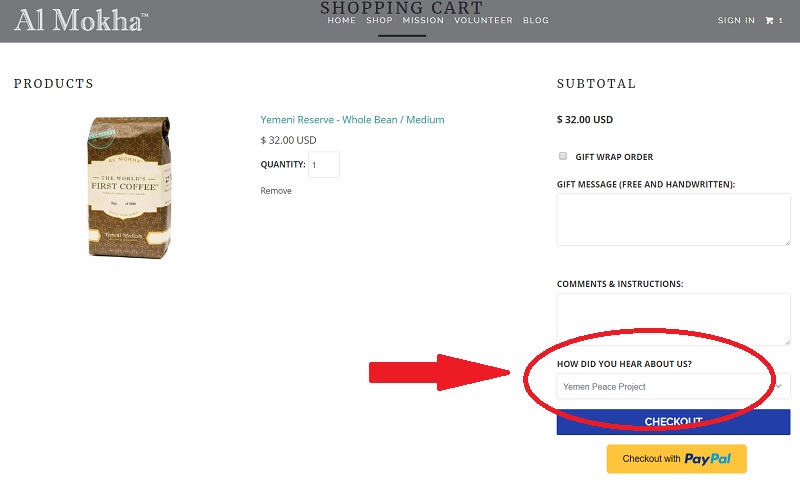
Yemen is the birthplace of coffee. The first coffee to be exported to the outside world was shipped from the ancient port of al-Mokha, from which Washington DC-based Al Mokha Coffee takes its name. By selling high-quality, authentic Yemeni coffee, Al Mokha creates sustainable jobs for Yemeni farmers and processors. This holiday season, give a great gift that does some good!
If coffee's not your thing, how about some art? We're offering limited-edition prints of selected photographs featured in our 2016 International Yemeni Film & Arts Festival. For each purchase, half of the proceeds go to the artist, and half to the YPP's arts & culture programming. You can also give the gift of peace with a special donation to our advocacy fund! Learn more here.
Finally, if you do your shopping on Amazon.com, Amazon will make a donation to the YPP for every purchase you make, at no cost to you! To learn more, visit Amazon Smile today.
Thanks for supporting the YPP this holiday season!
December 5-11: US calls for Hadi government to accept peace deal, Oxfam warns of increasing food crisis
November 28-December 4: Houthi formation of government elicits criticism, UN envoy struggles to restart talks
Monday, November 28: A Houthi political council announced that it has unilaterally formed a new government, a surprise and unwelcome move that will stifle the efforts of the UN envoy to Yemen who has been working towards creating a unity government.
November 21-27: Little hope for renewed ceasefire as airstrikes and clashes resume
Monday, November 21: Last week’s 48-hour ceasefire ended midday on Monday and will not be renewed, according to the Saudi-led coalition.
November 14-20: Forty-eight hour ceasefire begins with accusations of violations on both sides
Monday, November 14: US Secretary of State John Kerry arrived in Muscat, Oman for talks aimed at ending Yemen’s 20-month-long war.
November 7-13: Increase in deadly clashes along Yemen-Saudi border
Monday, November 7UN Special Envoy to Yemen Ismail Ould Cheikh Ahmed addressed reporters in San’a to reiterate his calls to end the conflict and highlight the need for increased humanitarian aid. "People are dying...the infrastructure is falling apart...and the economy is on the brink of abyss."
The World Health Organization released a statement on the same day, reporting that more than 7,070 people had been killed and over 36,818 injured as of October 25, while another 21 million people are in urgent need of health services.
The WHO also reports that more than half of all medical facilities in Yemen are closed or are only partially functioning and there is a critical shortage of doctors in 40% of all districts. A lack of access to healthcare means that many Yemenis are deprived of life-saving operations and treatments.
Tuesday, November 8 For election day in the United States, Al Jazeera interviewed citizens of Tunisia, Yemen, and Gaza about their opinions of this year’s candidates and US policy in the Middle East.
“We hope the upcoming US administration--be it Clinton or Trump--pays due attention to Yemen and is interested in resolving the current conflict, especially the humanitarian conditions that are deteriorating,” said one Yemeni man.
Another added, "I expect no change in US foreign policy, namely towards the Muslim world; especially with Trump. As for Hillary Clinton, I believe she will follow the same policies of Obama, namely to cause a rift among the Arabs and cause them to fight each other, while they stand as spectators."
During a visit to Lebanon, Iran’s foreign minister Mohammad Javad Zarif called for a political solution to the conflict in Yemen.
"We should admit that there is no military solution, neither for the Yemeni crisis nor for the Syrian crisis," Zarif said. "We believe that continuing to use military methods in order to win the Yemeni and Syrian crises will only lead to more fighting and bloodshed."
An analysis in the Huffington Post attempts to explain why Saudi Arabia continues its military campaign in Yemen despite the steep costs. One of the chief motives for pushing forward with the war is the kingdom’s desire to rally the public around a common Shi’i enemy, simultaneously distracting the Saudi populace from serious economic problems at home while inciting hatred of the kingdom’s regional rival.
An official in Hadi’s government reportedly told Anadolu News Agency that the exiled president considers a plan proposed by the UN to be “a betrayal of the blood of [Yemen's] martyrs.” The roadmap put forward by Special Envoy to Yemen Ould Cheikh Ahmed would marginalize Hadi's role in a proposed transitional period.
Wednesday, November 9 Pro-government forces in Yemen claimed to have killed 30 al-Qaeda suspects at a farm west of Mukalla. Four soldiers were also killed in the clashes.
The Sunday Times reports that the UK has deployed its most advanced warship, the HMS Daring, to the Red Sea to protect critical shipping lanes. Both US and UAE vessels have been targeted by Houthi forces in the Red Sea over the past month, while an oil tanker was attacked by pirates.
Thursday, November 10 Houthi military sources told Saba News Agency that their forces have captured the two Saudi towns of al-Kars and al-Dafiniya, killing dozens of Saudi soldiers. The sources claimed that this was a military response to the Saudi-led coalition’s continued targeting of Yemen’s infrastructure.
Friday, November 11 The sub-governor of the Central Bank of Yemen, Ibrahim al-Nahari, was dismissed by Hadi’s government following the relocation of the CBY from San’a to Aden. Al-Nahari was fired on the pretext of forging reports to foreign financial institutions, though no evidence for this accusation has been made public.
Saudi press reports that Houthi missiles fired into the kingdom’s southern Dhahran province injured 14 civilians. The same report claims that Houthi forces launched failed attacks in Al-Qabbaytah region of Lahj province, southeast of Ta’iz.
Sunday, November 13 UK Ambassador to Yemen Edmund Fitton-Brown writes for Al-Arabiya to explain a prospective roadmap for peace in Yemen:
“The terms of the roadmap would see the Houthi militia and Saleh loyalists withdraw from areas they have occupied, including the capital Sana’a and the cities of Taiz and Hodeidah. They would also be required to hand over their heavy weaponry.
“In return, a new Vice-President enjoying extensive national acceptability and credibility will be appointed who assumes full Presidential authority and oversees the formation of a new Government of National Unity. And it will be this Government which takes forward the political transition envisaged for Yemen back in 2012, leading to democratic elections and a new Constitution chosen by the Yemeni people.”
More than 350,000 Yemeni children were unable to resume their education in the past school year, bringing the total of out-of-school children in the country to over two million, according to UNICEF.
Thousands of students in Ta’iz now study in homes rather than at their former schools, over 2,000 of which have been either destroyed or repurposed as military facilities or humanitarian shelters.
An excellent article by Ben Hubbard in the New York Times offers insight into life on the ground in San’a and surrounding areas. Hubbard interviews average Yemenis who are facing extreme hardships including unemployment, malnourishment, and a lack of medical supplies.
The Yemeni army said in a statement that its forces and the Saudi-led coalition had struck Houthi sites in the districts of Midi and Harad in Hajjah province, killing “scores” of Houthi fighters.
A post-election call to action
Dear friends and readers, We don’t often write about American domestic politics, because they aren’t a major focus of the YPP’s work. But Tuesday’s elections in the US have serious repercussions for US policy toward Yemen, so I want to share with you all my own thoughts on the election results, and tell you how the YPP is working to give Yemenis and Yemeni-Americans a voice in Washington.
Whether one supports or opposes Donald Trump, it is clear that he lacks experience in foreign affairs, and has little understanding of the issues that affect Yemen and the US-Yemen relationship. Once in office, he will be surrounded by the Republican party’s odd mix of isolationists and interventionists. Trump is likely to appoint someone from his inner circle to the coveted position of Secretary of State; one likely candidate is Newt Gingrich, a disgraced former Congressman who has previously championed the primacy of the Pentagon over the State Department in matters of foreign policy. With little to go on other than Trump’s own statements to date and the past actions of his allies, we have to assume that his administration’s approach to geopolitics will be defined by short-sighted and brutish unilateral action.
On the domestic front, things are no better. Mr. Trump has welcomed white supremacists into his tent, empowering those who would discriminate against and attack Muslims and Arab Americans. He has pledged to ban Muslims from immigrating to the US, and to increase arbitrary surveillance of American Muslims. Acts of violence against religious minorities and people of color in this country are all but guaranteed to increase during Trump’s presidency; already, in the two days since the election, two Muslim women in different states have been assaulted by Trump supporters.
But I’m not writing to encourage you to be afraid. I’m writing to urge you to act. In the coming year, the Yemen Peace Project will expand our advocacy program to more effectively communicate the concerns and interests of Yemenis, Yemeni-Americans, and international experts to US policy makers. I need you to stand with us in this effort.
The YPP is America’s first and only advocacy organization dedicated solely to Yemeni affairs and the US-Yemeni relationship. That puts us in an ideal position to advise and coordinate the work of other organizations, and it allows us to serve as a permanent resource and point of contact for legislators, government officials, and members of the public.
Since launching our advocacy program a year and a half ago, we’ve established positive working relationships with several members of Congress, and with staff at the State Department and USAID. Our volunteer advocacy team--led by myself and board member Don Picard--also collaborates regularly with other organizations working on US foreign policy. Through these channels, we are working to end America’s military involvement in the ongoing war in Yemen, and to support the internationally-backed peace process. We have also established an independent working group of governmental, humanitarian, and economic experts to assist with Yemen’s recovery from this catastrophic war.
With your support, we can go into 2017 with an even stronger advocacy program. In the coming year, we plan to:
- Hire a full-time advocacy director and two advocacy interns to augment our current team;
- Continue our efforts to end US military action in Yemen and reach a peace agreement;
- Put forward a comprehensive plan for responsible and constructive US engagement with Yemen, for the duration of the Trump administration and beyond;
- Defend the civil rights of Yemeni-Americans, at the local and national levels;
- Continue to build support in Congress for the above efforts;
- And train new volunteer advocates--in particular Yemeni-American volunteers--to participate in future lobbying campaigns.
We know the road ahead will be difficult. We can only make progress with your help. Some of you have already donated to the YPP this year, and I deeply appreciate your support. If you’re able to make an additional gift to our advocacy campaign, or if you haven’t yet made a contribution, I hope you’ll consider doing so today. I look forward to updating you on our successes throughout the year.
In peace,
Will Picard, Executive Director
October 31-November 6: Parties tentatively consider peace deal under mounting pressure to end conflict
Monday, October 31At least 10,000 children in Yemen have died from preventable diseases since the war began in March 2015-- one of many disturbing statistics included in a recent statement by UNOCHA. The press release was also a plea to all parties to end the bloodshed and find an immediate political solution.
“Repeatedly over the past 19 months, the people of Yemen have been robbed of their lives, their hope and their right to live in dignity. Thousands have been killed, tens of thousands have been injured, more than three million have been forced to leave their homes, and seven million suffer the daily anxiety of not knowing where their next meal might come from.”
State department spokesperson John Kirby said in a daily press briefing that there are still no updates on the Saudi investigation into the October 8 funeral bombing, in which hundreds of civilians were killed or injured. “[The Saudis] acknowledged that mistakes had been made. But they are still working through that, and we look forward to hearing from them as they learn more and uncover more lessons learned about what happened there. So I don’t have an update...even if I did, it wouldn’t be for me to speak to it. It would be for the Saudi Government to speak to.”
A statement by US Ambassador to the UN Samantha Power called for an “immediate progress on three fronts [in Yemen]: an immediate cessation of hostilities; a humanitarian surge, the likes of which we haven’t seen in Yemen for the life of this conflict; and a prompt return to political talks.”
Reuters reports on Yemen’s north-south divide and the possibility of the country’s post-war fracture. As long as parties to the conflict cannot find a path to peace, let alone a path to a unified government, Yemen’s future remains uncertain.
"We realize that they have their own interests in supporting us because our forces are effective against the Houthis," a southern politician told Reuters on condition of anonymity. "They are worried that a break-up of Yemen into two states on their borders will lead to instability, but we know that separation is the only way to make a just peace."
A few Arabic language outlets reports on clashes in southeastern Ta'iz, which resulted in the deaths of ten Houthi fighters and one pro-government soldier.
The World Food Programme's Muhannad Hadi recently returned from Yemen, and describes in an interview with NPR the scenes of devastation and famine that he was faced with.
“The state of Yemen is broken...They feel that they are dying in silence. And they feel that they have been forgotten by the entire world.”
The report includes comments from former US ambassador to Yemen Barbara Bodine, who says the reason the US got involved with the war in Yemen was to facilitate the Iran deal, which Saudi Arabia clearly objected to.
“This is how we got into this. We need the Saudis for the Iran deal. Nobody anticipated this would last 18 months. No one anticipated the level of carnage...Now we are complicit in a fragile state being turned into a shattered state.”
VICE News also published a report on Yemen’s impending famine, including interviews with medical staff on the ground.
Tuesday, November 1 In a daily press briefing with state department spokesperson John Kirby, one journalist asked about the seemingly contradictory position of the US government on the war in Yemen; as the US assists the Saudi-led coalition yet claims to be seeking a peaceful political solution to the conflict. Kirby responded, stating repeatedly that the US is “on the side squarely of the Yemeni people,” but justified the coalition’s intervention by saying that “the Saudi Government has a right to defend itself and they are under attack almost every day from across that border. They have a right to defend themselves.”
Al Omgy Exchange, a firm accused of carrying out financial transactions with AQAP, has been placed on the US Treasury Department’s list of groups aiding terrorist organizations. Said Salih Abd-Rabbuh al-Omgy and Muhammad Salih Abd-Rubbuh al-Omgy are on the list as well for allowing AQAP to disperse funding throughout Yemen and receive deposits, including extortion payments from Yemeni businesses.
Monday’s comments by Samantha Powers at the UN have sparked criticism from US representative Ted Lieu and humanitarian organizations, who have pointed out US hypocrisy when it comes to condemning violence in Yemen.
"Ambassador Power's remarks, calling for an end to unlawful strikes that kill civilians and hit protected civilian objects, are certainly welcome. But the U.S. has repeatedly failed to acknowledge its own role providing vital support to those airstrikes by refueling coalition planes and continuing to supply Saudi Arabia with U.S. weapons," says Priyanka Motaparthy, senior emergencies researcher at Human Rights Watch.
Wednesday, November 2 Houthi forces have reportedly displaced 150 families from their homes near Ta’iz since clashes between the rebels and pro-government forces escalated on Monday.
Fifty families were evicted from the towns of al-Dayh and al-Rawd, west of Ta’iz, while 100 others were forced to leave al-Silw district in the east.
RT interviewed Catherine Shakdam, the Director of Programs at Shafaqna Institute of Middle Eastern Studies, to learn more about Saudi Arabia’s military goals in Yemen and the sources of funding that allow the conflict to continue.
Thursday, November 3 Time outlines four important points about the war in Yemen, including the impending humanitarian crisis, America’s role in the conflict, and the economic and political impact that will remain far into the future.
Coalition spokesperson Ahmed al-Asiri was interviewed by the BBC, where he listed reasons that Saudi Arabia is not to be blamed for the catastrophic situation in Yemen, adding that “Saudi Arabia will not allow Yemen to deteriorate into ‘a failed state like Libya.’”
Assailants of last Tuesday’s suspected piracy attack in the Red Sea were found to be carrying a “substantial amount of explosives,” the vessel’s owner says, raising suspicions that the incident was an attempted suicide attack.
The shipping company stated that "While the intentions of the attackers and the use of the explosives is unknown, the investigation findings indicate that the explosives would have been sufficient to have caused significant damage to the vessel...It appears, however, that when the skiff was approximately 20m (meters) from the vessel, the explosives detonated, destroying the skiff and ending the attack."
Whatever the motives were for the attack, increased fears of piracy in Red Sea shipping lanes will tighten delivery of critical fuel and supplies to Yemen.
Representative Ted Lieu (D-Calif.) sent a letter to Defense Secretary Ash Carter and Secretary of State John Kerry to inquire about an official’s recent comment that US support for the coalition does not include target selection and review.
“I find it deeply troubling that the U.S. apparently has no advanced knowledge of what targets will be struck by jets that are refueled by U.S. personnel with U.S. tankers,” Lieu wrote.
“The U.S. would appear to be violating LOAC and international standards by engaging in such direct military operations if U.S. personnel are not aware if targets are civilians or military, if the loss of life and property are disproportional, or if the operation is even militarily necessary...U.S. personnel are now at legal risk of being investigated and potentially prosecuted for committing war crimes.”
An anonymous senior diplomat at the United Nations told Reuters that Saudi Arabia appeared broadly to accept a peace plan initiative and had encouraged Hadi to do so as well.
"As far as I'm aware the Saudis have accepted the roadmap ... they have certainly done a very good job behind the scenes of encouraging Hadi to get closer on the spectrum of accepting it than he previously was," said the diplomat.
A reporter from The Intercept asked Saudi Ambassador to the US Prince Abdullah al-Saud if the kingdom will continue to use cluster bombs in Yemen, to which the ambassador replied, “This is like the question, ‘Will you stop beating your wife?’” He added that he was “not a politician,” and said that Saudi Arabia will continue to bomb the Houthis “no matter what it takes.”
Al Jazeera reports that thousands of Yemenis protested in Aden against the new peace plan proposed by UN Envoy Ould Cheikh Ahmed, citing its support of the rebels “power grab.” Photos from the protests, however, appear to show participants waving the flag of South Yemen, with signs promoting a path to southern independence.
The founder of a pro-southern independence group, Salah Haydara, spoke with Aden Al Ghad and explained the southern movement’s presence at these demonstrations. Haydara said that southerners support the legitimate government as long as it is in the interest of southern independence, adding “There is no legitimacy without the legitimacy of the southern people.”
Nasser al-Sakkaf reports on the uptick of robberies in Yemen’s cities, a result of the desperate situation that many citizens find themselves in.
One prisoner that al-Sakkaf interviewed said that he had “sold most of the equipment and furniture in my house, including the bottle of propane and the beds. My children were starving to death so I had only two choices: either to beg or to steal.”
Friday, November 4 The US Department of State announced that Secretary John Kerry will travel to Muscat on November 14 to meet with Sultan Qaboos and Foreign Minister Yusuf bin Alawi “to discuss Yemen and efforts to reach a peaceful settlement to the conflict there. The Secretary will then travel to Abu Dhabi, United Arab Emirates, on November 15 to meet with Crown Prince Mohammed bin Zayed to discuss challenges facing the region.”
Yemen’s ousted president Saleh, now allied with the Houthis, has reportedly welcomed a peace plan proposed by the UN, commenting on social media that it is a “good basis for negotiations."
Abdullah al-Ibbi, who lost 27 members of his family during a Saudi airstrike on his home, spoke to the BBC about his devastating loss and his attempts to recover.
"Sometimes I sleep two, three hours and then I wake up and stay up until morning... I remember my children and my home...Our lives were humble but it was a quiet life, a good life, we were happy...we lost everything."
Maia Baldauf, the program and reporting officer for Mercy Corps in Yemen, writes for Huffington Post to describe life in San’a under airstrikes and raise awareness about the desperately-needed food and medical aid that millions of Yemenis are lacking.
“Currently, over 14 million people ― more than half the population ― are unsure of how they will provide food for themselves. More than 19 million people lack access to safe water. Some 3 million young children and pregnant and nursing women are acutely malnourished or in need of services to prevent acute malnutrition...The world needs to understand this is one of the most massive humanitarian crises in the world.”
The Boston Globe examines America’s role in Yemen’s war, both as a potential peacemaker and as a current supplier for many of the weapons used in Saudi Arabia’s continued airstrikes.
Saturday, November 5 The Huffington Post reports that Nujood Ali, the subject of the film, “I Am Nujood, Age 10 and Divorced,” had met Hillary Clinton on a few occasions. The now 19-year-old has stated that she believes a Clinton presidency would mean a more peaceful Yemen.
“The moment I heard that she would be nominated as U.S. president, I thought things would definitely improve in Yemen. For sure.”
Hillary Clinton's position on the conflict in Yemen was subject to scrutiny last week when her national security advisor Michael Morell advocated for the US military to board Iranian vessels in international waters to demonstrate support for the Saudi coalition, a move that would be considered an act of war.
Vince Cable, a former Cabinet minister, says the UK defense ministry misinformed him about weapons deals with Saudi Arabia, leading the former business secretary to sign off on arms transfers. Cable said he was given assurances the UK would be granted oversight of where British-made weapons were used.
"My very clear understanding was that the equipment would be supplied to Saudi Arabia on the very clear basis that British personnel would have oversight of what the Saudi air force was doing, on the same basis as the Americans."
Overwhelming evidence indicates that both American and British-made weapons have been used in the commission of war crimes in Yemen.
Sunday, November 6 Wallead Yusuf Pitts Luqman, an American held in Yemen by Houthi forces for a year and a half, was released to Oman, according to a statement by US Secretary of State John Kerry.
Kerry thanked Oman’s Sultan Qaboos, adding, “We also recognize this positive gesture by the Houthis.”
Mareb Press reports that a Houthi delegation traveled from San’a to Muscat on Sunday. The reasons behind the visit are unclear, but is likely related to a recently proposed peace deal. US Secretary of State John Kerry will also be arriving in Muscat on November 14 to speak with officials.
An editorial in the Guardian calls for an end to Yemen’s war and a block of continued weapons transfers to Saudi Arabia. The article points out the absurdity and hypocrisy of American and British policy in the conflict:
“Half of the $115bn (£92bn) worth of weapons sales agreed under the Obama administration are still in the pipeline. Meanwhile, its ambassador to the UN, Samantha Power, has urged Riyadh to halt indiscriminate strikes. The UK, which has licensed £3.3bn worth of sales since the Yemen conflict began, boasts of increasing aid by £37m. The pledge would be laughable if it was not so shameful. By August, the damage caused by war already stood at an estimated $14bn. The aid will go only a short way to repairing that – and no sum can restore lost limbs or revive the dead.”
October 24-30: Proposed peace deal rejected by Hadi, coalition targets Hudaydah prison
Monday, October 24Jordan’s Prime Minister Hani Mulki met with his Yemeni counterpart Ahmed bin Daghr in Amman to reassert his country’s support for “legitimacy in Yemen and efforts exerted to restore its stability and security.” Mulki also affirmed his support for a political solution to Yemen’s crisis.
New street art in San’a depicts the horrors of Yemen’s war and humanitarian crisis. One of the participating artists, Thi Yazan al-Alawi said, "We came up with this campaign because of the internal and external wars in Yemen, the economic crisis, all of these factors led to famine and poverty in Yemen.”
Tuesday, October 25 Saudi ambassador to the UK Mohammed bin Nawaf bin Abdulaziz wrote in The Daily Telegraph to say that there had been “an alarming change in the way Saudi Arabia is discussed in Britain” in the last few weeks.
The ambassador is referring to a recent move by Labour leader Jeremy Corbyn to cancel a £5.9 million prison consultancy contract with Saudi Arabia, due to concerns over human rights violations within the kingdom. Corbyn has also voiced objections of Saudi Arabia’s campaign in Yemen.
Mr. Abdulaziz added, “If the extensive trade links between the two countries are going to be subordinate to certain political ideologies, then this vital commercial exchange is going to be at risk. We want this relationship to continue but we will not be lectured to by anyone.”
UN Special Envoy to Yemen Ismail Ould Cheikh Ahmed submitted a proposal for a peace plan to both parties. The plan stipulates that exiled president Hadi would be stripped of his authority and Houthi forces would need to withdraw from major cities.
“According to [a] Houthi-affiliated politician, the peace plan also includes transferring the powers of the internationally-recognized president to a new prime minister and a vice president, in addition to the formation of a national unity government, while easing out Houthis from cities under their control. The deal also suggests the formation of a team of international observers to supervise the militias’ withdrawal. It proposes a one to two-year-transitional period paving the way for presidential elections.”
General Joseph Votel, head of US Central Command, travelled to Riyadh to meet one-on-one with members of the House of Saud in an attempt to repair recent damage done to US-Saudi diplomatic relations.
Simon Henderson, a fellow at the Washington Institute on Near East Policy, says “The administration — the White House — is thoroughly fed up” with the Saudi government. Similarly, “The Saudis want to see the back side of the Obama administration. They don’t mind too much whether it’s Hillary Clinton or Donald Trump, as long as it’s no longer Obama.”
Shocking photos of a starving and emaciated 18-year-old from al-Hudaydah were circulated this week, illustrating the desperate situation in Yemen’s port city and other parts of the country that are facing a severe shortage of food and medicine due to blockades imposed by both the Saudi-led coalition and Houthi forces.
Shipping group Teekay said one of its gas tankers "experienced a suspected piracy attack whilst off the coast of Yemen" near the Bab al-Mandeb Strait on Tuesday. None of the unknown assailants managed to board the vessel, which departed the strait safely.
British maritime security firm MAST said the assailants approached the tanker in a small boat and fired a rocket propelled grenade. MAST added that it is “unclear whether this is a terrorist attack or piracy.”
Wednesday, October 26 New York Magazine reports on some disturbing proposals made by Hillary Clinton’s national security advisor Michael Morell, who said that he “would have no problem from a policy perspective of having the U.S. Navy boarding [Iranian] ships, and if there are weapons on them, to turn those ships around,” referring to the reported weapons shipments to the Houthis.
As the article points out, forcibly boarding another nation’s vessels in international waters amounts to an act of war, which would likely drag the US further into the war in Yemen on the side of Saudi Arabia.
A call by the UK’s Labour party to withdraw support from the Saudi-led coalition failed to pass, after about half of the party, or 100 parliamentarians, abstained from voting. This resulted in a 283-193 vote rejecting the call to suspend arms sales to Saudi Arabia until an independent UN investigation into war crimes in Yemen was completed.
An article in Al-Monitor explores Turkey’s policies and positions relating to Yemen and how they have evolved since Saleh was ousted in 2012.
Thursday, October 27 Commander of US Naval Forces Central Command Kevin Donegan told NBC news that the US military believes Iran has supplied weapons to the Houthis, including coastal defense cruise missiles like the ones used in attempted attacks on a US vessel earlier this month. Donegan disclosed that the US and partner nations have intercepted five weapons shipments from Iran that were headed to the Houthis in Yemen.
Emily Thornberry, UK shadow foreign secretary, says she is disappointed with members of her party for abstaining from Wednesday’s vote, and disgusted with the Conservatives who voted against withdrawing support for Saudi Arabia.
“Yesterday’s motion gave us the opportunity to send the opposite message to the world … that, while Saudi Arabia will remain a valued strategic, security and economic ally in the years to come, our support for their forces in Yemen must be suspended until the alleged violations of international humanitarian law in that conflict have been fully and independently investigated. And until the children of Yemen have received the humanitarian aid that they so desperately need,”
Friday, October 28 Saudi Arabia accused Houthi forces of targeting the holy city of Mecca with a ballistic missile fired over Yemen’s border. The Saudi military claims to have intercepted the missile 65km from Mecca.
Houthi leadership strongly denies the accusation, saying that the Saudis are spreading propaganda to incite Muslims against the Houthis and to distract from their own crimes committed against the Yemeni people.
The UN World Food Programme (WFP) fears that hunger will take a devastating toll on Yemen. The organization says it has provided food for more than 3 million people each month since February but is beginning to split these depleted rations so it can reach 6 million people every month.
"An entire generation could be crippled by hunger," says Torben Due, the program's director in Yemen.
According to the WFP, almost half of all children in Yemen are stunted, a sign of chronic malnutrition.
The Huffington Post interviews US officials, congressmen, and activists to assess Obama’s policy in Yemen following claims by his administration that the US would be reviewing its support of the Saudi-led coalition.
The International Office for Migration, affiliated with the UN, is launching an appeal for $150 million of urgent assistance for Yemenis in need of food, clean water, and medicine.
Saturday, October 29 A coalition airstrike hit a home in southwestern Ta’iz’s al-Salw district, killing 17 civilians, according to local officials and residents.
Exiled president Hadi met with UN Envoy Ould Cheikh Ahmed in Riyadh, but refused to even receive the envoy’s proposed peace deal. The plan would reportedly require Hadi to resign and set up a government of less divisive figures.
"The ideas presented ... carry the seeds of war," a statement by the presidency quoted Hadi as saying. "It rewards the coup leaders and punishes the Yemeni people at the same time."
The World Health Organization reports that over 1400 suspected cholera cases have been declared in the last three weeks. The outbreak of the deadly disease is up from only eight cases earlier this month, and is largely due to the war’s impact on health facilities and a lack of clean water.
A car bomb detonated near the new location of Yemen’s central bank headquarters in Aden, injuring five. No group has claimed responsibility for the attack.
Sunday, October 30 Saudi-led airstrikes hit a prison and security site in al-Hudaydah, killing 60, including inmates. A statement released by the coalition said that the building was “used by Houthi militia and the forces of the deposed president as a command and control center for their military operations,” and claimed that “targeting protocols and procedures were followed fully."
Mafraj Radio #28: Wartime Journal bonus episode
This episode features another entry in our Wartime Journal series. We’ve asked contributors in different parts of Yemen to record audio journal entries for us, conveying their own personal experience of Yemen’s ongoing war. Our first installments featured recordings by an anonymous civil servant living in San’a. That same contributor offers her observations on how Yemen’s war has pushed millions of Yemenis into deep poverty, and even starvation.
Cholera outbreak deepens Yemen's misery
We're pleased to feature a guest post by Ibrahim Daair on the recent outbreak of cholera in Yemen, where the healthcare system has already been devastated by war and poverty. This article originally appeared on The Conflict Comment blog. This post does not necessarily reflect the positions of the YPP; YPP staff have not attempted to fact-check or independently verify the information reported herein. With the war leaving many of the country’s hospitals in ruins, a cholera outbreak could push Yemen’s health system over the brink, further shattering the already traumatised country.
Government officials in Northern Yemen have confirmed several cases of cholera, and this news cannot come at a worse time for the country, already one of the world’s poorest, as it undergoes a violent war involving neighbouring Saudi Arabia.
The majority of cholera cases have been reported in Sana’a. The World Health Organization (WHO), citing the Sana’a based Ministry of Health, reported 11 confirmed cases in the capital.
WHO officials also stated that the disease does not appear to be spreading. However, local media, quoting medical sources, also contained reports of two children contracting cholera in the southern governorate of Lahj. Local government officials were quick to deny the reports, claiming they were cases of food poisoning.
Cholera, which causes severe dysentery and vomiting, can develop in areas with poor sanitation and is contracted by coming into contact with contaminated water sources. Without effective treatment the disease can have a mortality rate of up to 90 per cent.
Any disease outbreak will undoubtedly put additional strain on a health system struggling to cope with the effects of war. The UN estimates that around 10,000 civilians have been killed due to the conflict; the majority by Saudi airstrikes.
A coalition of Arab states led by Saudi Arabia began a bombing campaign in March last year after Ansarullah (Houthis) and forces loyal to former president Saleh took control of large territories across Yemen, forcing the internationally recognized government of president Hadi into exile in Saudi Arabia.
Yemen has been in a state of upheaval since 2011, when popular protests forced president Saleh from power. Saleh handed power to his deputy Abd-Rabbuh Mansour Hadi in a deal which gave him immunity from prosecution. The deal, sponsored by the GCC states, was seen as giving Saleh the ability to wreck Yemen’s transition toward democracy.
Yemen’s hospitals have not been immune to the war. Several have been targeted throughout the country. In August, a Saudi airstrike hit an MSF run facility in the North-West of the country. The attack killed 19 and destroyed the last functioning hospital in the area.
Julien Harneis, UNICEF’s Yemen representative, said ‘Children are at a particularly high risk if the current cholera outbreak is not urgently contained especially since the health system in Yemen is crumbling as the conflict continues.’
Furthermore, the medical situation is worsened by the nation-wide blockade enforced by the Saudi-led coalition on the country. By barring all sea and air traffic into Yemen, the Saudis aimed to turn public opinion against the rebels and pressure Ansarullah and Saleh loyalists to retreat from the capital.
However, more than a year on, it has had devastating effects on the country’s medical system, making it extremely difficult to import medication. Hospitals throughout the country have reportedly had to turn away patients because they lack the capacity to treat them.
The blockade is being blamed for an increasingly wide-spread humanitarian crisis. Reports indicate that up to 80 per cent of Yemen’s population is in need of humanitarian assistance, while malnutrition is affecting up to 1 in 3 children.
In addition, Yemen has suffered chronic water shortages as a result of poor management and inefficient infrastructure to conserve drinking water. Yet despite the on-going war, farmers are still producing the local cash crop. The production of Qat, a leaf that acts as a mild stimulant when chewed, consumes a large amount of water. With Qat and mismanagement already putting pressure on water resources, the war is exacerbating the situation by making it difficult for many to access clean drinking water. A vital resource in combatting the spread of cholera.
This week, the Saudi-led coalition was accused of bombing a funeral hall in the capital Sana’a which led to the deaths and injury of hundreds of attendees. After initially denying any involvement, the Saudis have apparently accepted responsibility in the wake of an international outcry. The scale of the bombing led hospitals in the capital to issue a call for volunteers to donate blood to critically injured survivors.
UN secretary-General Ban Ki Moon labelled the attack ‘an outrageous violation of international humanitarian law’ and called for a full inquiry. He also condemned all sides for attempting to ‘hide behind the fog of this war’.
The UN has organized a number of peace talks in a bid to end the war. The latest round of negotiations in Kuwait earlier this year fell through after Saleh’s party, the GPC, and Ansarullah unilaterally announced the formation a new government.
Last month the Saudi backed government in exile announced that it would move the central bank to Aden, the temporary capital. The bank was seen as the last functioning non-partisan bureaucracy keeping the economy from completely collapsing.
On the other side, the Houthis and Saleh are not willing to surrender their weapons nor allow the exiled government to return to power in Sana’a.
As the fighting continues the financial cost of the war is mounting on Saudi Arabia. The unintended length of the war coupled with a persistent slump in oil prices and growing financial crisis are putting heavy pressure on the Saudi monarchy to get out of the Yemeni quagmire. The quickest way out for the Saudis would be to drop Hadi and allow the formation of a unity government without him. However, this would involve a serious loss of face that the kingdom’s rulers cannot tolerate.
For any meaningful peace to be negotiated all sides must move away from their increasingly entrenched positions and think in terms of their, and Yemen’s, future interests. A long protracted war will only serve to further destroy the country and diminish public support for either side.
The current war is not the only concern to bear in mind: “The only thing keeping the country’s ‘two sides’ together are shared enemies” said Adam Baron, a journalist on Yemen. Those divisions have not gone away, rather the war has simply placed them on the back burner.
During his tenure as president Saleh fought six wars against the Houthis. For their part the wide confederation fighting alongside the Hadi government includes local tribes, Al-Qaeda and secessionist elements; many of whom are also deeply opposed to Hadi. In the event of the current war coming to an end, Yemenis will still face the daunting task of keeping the peace between the many heavily armed sides.
The cholera outbreak is the latest in a long line of events pushing the Yemeni population to its limits. Unless steps are taken to stop this outbreak in its tracks, the addition of a serious medical crisis could turn Yemen into an even greater humanitarian catastrophe.
October 17-23: Three-day ceasefire begins and ends, airstrikes resume
Monday, October 17Saudi Foreign Minister Adel al-Jubeir announced that the coalition is prepared for a ceasefire: "We would like to see a ceasefire yesterday...Everybody wants a ceasefire in Yemen, nobody more so than the kingdom of Saudi Arabia and the coalition members," Jubeir told reporters in London, adding that he was skeptical that a truce would hold.
Houthi publications show evidence of Spanish-made weapons being used by the rebels in Yemen, including a C90 grenade launcher manufactured by Instalaza and a BMR-600 military vehicle made by the Spanish company Enasa. El Pais reports that the weapons likely found their way into Houthi hands via Saudi Arabia, Spain’s biggest arms purchaser outside of Europe.
PBS NewsHour interviewed former US ambassador to Yemen Barbara Bodine in a segment on last week’s repeated targeting of the USS Mason in the Red Sea. Bodine says that the failed attack was “probably a direct retaliation for the Saudi bombing of the funeral hall,” but to the US, it was a “narrow act of self-defense”.
Tuesday, October 18 UN Special Envoy to Yemen Ismail Ould Cheikh Ahmed announced a 72-hour ceasefire for Yemen starting Wednesday night. The ceasefire is subject to renewal and there are hopes that it will be the first step to resuming peace talks.
There are reports that Egypt’s air force has withdrawn from the coalition in Yemen, but no official statement has been made confirming this.
Laura Kasinof writes for Slate, explaining why the widespread portrayal of Yemen’s crisis as a proxy war between Saudi Arabia and Iran is misleading.
“The war in Yemen is more of an ongoing domestic power struggle that has spiraled out of control and was exacerbated by the political upheaval of the Arab Spring. When outside countries became involved militarily, Yemen was wedged into the pressure cooker of Middle East geopolitics, making it even harder to reach a modicum of peace.”
Wednesday, October 19 A 72-hour ceasefire began just before midnight on Wednesday following a day of intensified airstrikes on army barracks in the capital by the Saudi coalition. The coalition says it will respect the ceasefire if the Houthi forces do as well, and will allow humanitarian aid to be delivered.
The UN says it is ready to deliver aid as soon as ceasefire begins, but humanitarian coordinator for Yemen Jamie McGoldrick is calling for an extension to the ceasefire, emphasizing that three days is not nearly enough time to deliver the necessary aid.
Deutsche Welle provides an outline of Yemen’s conflict and the various players while presenting possible outcomes for this week’s ceasefire. Vincent Durac, Middle East expert at the School of Politics & International Relations in Dublin told DW, “...there is a certain fatigue on both sides, and that could lead each to the conclusion that continued fighting will not create new advantages.”
The press secretary for Canada’s Minister of Foreign Affairs attempted to assure the public that there is no reason to believe that Canadian weapons are not being used in the commission of war crimes by the Saudi-led coalition in Yemen, allowing the country’s billions of dollars worth of arms sales with the kingdom to continue.
Britain’s minister for the Middle East Tobias Ellwood says that Saudi Arabia did not authorize the October 8 attack on a funeral hall in San’a, saying that an individual deliberately “breached” procedure and will now be disciplined.
Speaking to BBC’s Daily Politics about criticism of the UK’s relationship with the kingdom, Ellwood said that, "We do sell arms to Saudi Arabia, this is a legitimate war that's taking place, endorsed by the UN resolution 2216.”
Prime Minister Theresa May was questioned by a member of parliament about the UK’s role in Saudi war crimes, but she declined to give assurances that British-made weapons have not been used by the coalition to target civilians. May claimed that “the Saudi Arabian government have properly investigated these issues,” adding that “we press for proper investigations into what has happened on those incidents before we reach a decision or a conclusion on what has happened in relation to those incidents. We do have a very strong relationship with Saudi Arabia that is important for this country – it is important in terms of dealing with counter terrorism and a number of other issues.”
Thursday, October 20 On the first day of the ceasefire, Saudi Arabia claimed that the Houthis committed dozens of violations of cross-border shelling, with one attack killing two Saudi citizens. Meanwhile, Houthi officials charged the coalition with launching an airstrike that killed three civilians.
Al Jazeera reports that a total of at least 11 people were killed in the first day of the ceasefire, undermining the truce that was meant to facilitate the delivery of humanitarian aid. Those killed include five pro-government fighters in Sa’dah and Hajjah provinces and three rebels who died in attacks in al-Hudaydah.
A number of American, Yemeni, and other officials told Reuters that Iran has stepped up its weapons shipments to the Houthis using smuggling routes in Oman. One US official said that they are bringing “anti-ship missiles, explosives... money and personnel.” None of the officials quoted, including an Iranian diplomat confirming the claims, were named.
Oman’s Foreign Minister Yousef bin Alwi said last week that there was "no truth" in the claim.
Meanwhile, spokesperson for the US Department of State John Kirby evaded a question about Oman allowing the smuggling of weapons, saying that “we’ve been very clear about our concerns with all of the partners in the region, including Oman, regarding the risks that these weapons used in these kinds of attacks pose to maritime traffic in the Red Sea, and also the risks that future incidents could inadvertently expand the conflict in Yemen.”
Australia’s foreign minister Julie Bishop has confirmed that Craig Bruce McAllister, a football coach working in San’a, has been kidnapped by an unnamed group. A video was released following his capture, showing McAllister saying he was kidnapped and that the group is demanding a ransom.
Friday, October 21 Accusations of ceasefire violations continue, with Saudi Arabia saying that the Houthis have fired rockets into Saudi territory and launched attacks inside Yemen, while the rebels claim that the coalition has struck a number of sites in the border region of Shad.
The UN sanctions monitors told the Security Council that the Saudi-led coalition violated international humanitarian law when it used a “double-tap” airstrike on a funeral gathering earlier this month, killing over 140 people.
"The second air strike, which occurred three to eight minutes after the first air strike, almost certainly resulted in more casualties to the already wounded and the first responders," the UN monitors said.
State department spokesperson John Kirby was repeatedly questioned at a press conference about the outcome of the US review of support for the Saudi-led coalition. Kirby did not reveal details of the the review, but claimed it is ongoing.
The US Department of Defense announced that military strikes in Yemen have killed eight alleged al-Qaeda operatives. The first strike, on October 6, killed two operatives, while another on October 16 killed six. Both strikes took place in Shabwah governorate in central Yemen.
Saturday, October 22 The UN is seeking an extension to the three day ceasefire, which was scheduled to end at midnight on Saturday. An extension of the truce seems unlikely amid accusations of violations by both sides. General Ahmed al-Asseri, spokesperson for the coalition and commander of the Saudi 4th Brigade on the border in Najran, told Reuters his forces were defending against an attack by the Houthis.
"The violation of the truce was not from our side. It was from the other side. We are continuing to thwart them," Asseri said. "In the last 48 hours there was an enormous push by the enemy against our territory."
The Liberal Democrat party revealed that the UK has been training the Saudi Air Force, adding another dimension of British support to the Saudi-led coalition’s campaign in Yemen. Defence Secretary Michael Fallon said the Royal Saudi Air Force was helped in order to “improve their targeting processes.”
Sunday, October 23 Coalition airstrikes and cross-border shelling by the Houthis resumed at dawn following the end of the ceasefire. Military sites in San’a in the Hafa camp to the east and in the Nahdein area in the south were targeted, along with radar positions in al-Hudaydah and in Ta’iz, residents reported.
UN humanitarian coordinator in Yemen Jamie McGoldrick commented on the ceasefire, saying that the UN, the Red Cross and MSF have, for the first time, had three straight days to provide food and health support to San’a without the threat of airstrikes.
Robert Fisk writes about the Saudi coalition’s intentional targeting of Yemen’s farmland and the destruction of rural livelihood.
“...there is substantial evidence emerging that the Saudis and their “coalition” allies...are deliberately targeting Yemen’s tiny agricultural sector in a campaign which, if successful, would lead a post-war Yemeni nation not just into starvation but total reliance on food imports for survival.”
October 10-16: US launches attack on Houthi stations; Saudi says funeral strike was mistake
Monday, October 10Stopping short of accepting responsibility for last week’s bombing of a San’a funeral, the coalition says it “regrets” the strike and promises to release results of an investigation into the incident. It also agreed to British participation in the investigative process. Meanwhile, UN Secretary-General Ban Ki-moon said the bombing was “a heartless attack on civilians and an outrageous violation of international humanitarian law.”
UK Foreign Office minister for the Middle East Tobias Ellwood is due to hold talks with Saudi Arabia's Foreign Minister Adel Jubair, exiled president Hadi, and the UN Special Envoy for Yemen.
Photos surfacing on social media show fragments of US-made explosives used in last week’s Saudi bombing of a funeral in San’a, which killed at least 140 people and injured hundreds more.
Emails and other records obtained by Reuters show that US officials were concerned that last year’s $1.3 billion arms sale to Saudi Arabia would lead to the US being implicated in war crimes, as anonymous state department officials were skeptical that Saudi airstrikes would be capable of avoiding civilians. This article lays out the theoretical legal precedent for the US being charged with war crimes for its participation in Yemen’s conflict.
The US Navy commented on Sunday’s targeting of one of its vessels in the Bab al-Mandeb Strait, saying that it is unsure if the missiles, fired from Houthi-held territory, were aimed intentionally at the USS Mason.
Tuesday, October 11 Following last week’s deadly funeral bombing, international organizations (and the New York Times’ editorial board) have been ramping up pressure on the US to halt its support for the Saudi-led campaign in Yemen. The White House stated that its support for the kingdom “is not a blank check”.
“In light of the attack over the weekend, with the scrutiny that that attack legitimately calls for, we are going to undertake additional reviews of aid and assistance that goes to Saudi Arabia,” State Department spokesman John Kirby said during a press conference.
Kirby, however, defended the coalition’s actions and internal investigations following a question about the difference between bombing civilians in Syria and in Yemen.
Amy Goodman interviewed Nasser Arrabyee to comment on the devastating funeral airstrike.
“The big criminal is Obama himself," Arrabyee says. "This is how Yemenis see to the situation, because every Yemeni believes that Saudi Arabia would not have done that at all, would not have done a war in Yemen, without the approval of Obama.”
The Pentagon hints at retaliation for Sunday’s missile attack on USS Mason launched from Houthi-held territory.
"Anybody who takes action, fires against U.S. Navy ships operating in international waters, does so at their own peril," Pentagon spokesperson Captain Jeff Davis told a news briefing.
Saba News Agency reported that at least six military and security personnel were killed in last week’s airstrike. They include three commanders of the Republican Guard, loyal to former president Ali Abdullah Saleh: General Ali al-Jaefi and Brigadiers Abdulmalik Marzooq and Ali al-Hamzi. General Ahmed Manea, a member of the Supreme Security Committee, deputy security chief of Sanaa province, Ahmed al-Shalef, and head of the rebels' civil status authority, Brigadier Yehya al-Rowaishan, were also listed as killed in the attack.
Wednesday, October 12 Although some hope that last week’s airstrikes will put pressure on both sides to return to the negotiating table, April Longley Alley argues that mounting violence and the death of a number of prominent personalities will “empower hard-liners over peacemakers while undercutting capacity to implement any future accord.”
Yemen is in the running for an Oscar for the first time ever with the film I Am Nojoom, Age 10 and Divorced, which tells the real-life story of Nojoom who was married at the age of nine and struggled to obtain a divorce from her 30-year-old husband. The film was directed by Khadija al-Salami and filmed in Yemen.
The USS Mason was targeted a second time in the Bab al-Mandeb Strait. The missiles, fired from Houthi-controlled territory, did not strike the vessel.
Thursday, October 13 In its first direct military action against the Houthis, the US Navy launched Tomahawk cruise missiles into Houthi-controlled territory, destroying three coastal radar sites.
The strikes took place after missiles from Houthi-controlled territory unsuccessfully targeted the USS Mason twice in the past week.
Pentagon spokesperson Peter Cook said, “These limited self-defense strikes were conducted to protect our personnel, our ships, and our freedom of navigation in this important maritime passageway...The United States will respond to any further threat to our ships and commercial traffic, as appropriate, and will continue to maintain our freedom of navigation in the Red Sea, the Bab al-Mandeb, and elsewhere around the world.”
“We don’t seek a wider role in this conflict,” adding that the strikes were “not connected to the broader conflict in Yemen.” Cook also said, “Should we see a repeat, we will be prepared to take appropriate action again.”
The US strikes are seen by some Yemenis, and portrayed by Houthi leadership, as evidence that the US is continuing to wage a direct war on Yemen.
“The Americans have been patronizing and directing the war from the very beginning,” said Brig. Gen. Sharaf Luqman, a spokesman for the rebel alliance.
Chairman of the Houthi governing council Saleh al-Samad said in a statement that the strikes by the US vessel were “direct American intervention” and a final move of desperation. Samad added that the US has taken to “fabricating lies and pretexts in order to justify an extensive military operation along the coasts of al-Hudaydah, al-Mokha, and Bab al-Mandeb.”
Abdalmalik al-Houthi, the movement’s leader, also released a statement calling the US action a crime that is intended to pave the way for an operation targeting al-Hudaydah.
Also on Thursday, Iran deployed two vessels to the Red Sea “to protect the country’s trade vessels against piracy,” according to Iran’s Tasnim News Agency. Foreign Policy points out that piracy no longer exists in that area.
Speaking to the Washington Post, an anonymous US official said that future military assistance to Saudi Arabia may partly hinge on their willingness to embrace an “urgently needed” ceasefire.
“We are telling the Saudis that supporting their territorial integrity, their sovereignty, that’s one thing. But their campaign inside Yemen is something else, particularly if they’re not prepared to accept the unconditional, immediate cessation of hostilities that we’ve called for,” the official said.
Friday, October 14 President Obama tells Congress that Thursday’s strikes on Houthi targets were a “limited and proportionate” response to threats against US vessels in the Red Sea.
Meanwhile, senior administration officials held a briefing on the strikes, emphasizing that they were in self defense and “not meant to indicate support for coalition operations either in Yemen writ large or on the Red Sea. And we also made clear in public statements that we were not intending to be brought into the war in any fashion.”
One of the officials confirmed that the US is “certain” that the missiles were launched by Houthi forces, but the motives for the targeting of a US vessel is still unclear.
Former US ambassador to Yemen Stephen Seche speaks to NPR’s Morning Edition about the extent of America’s involvement in Yemen’s war and outlines what each party in the conflict wants.
“One of the key moments we face now is to not internationalize this conflict any further. It's already been deeply distorted by the 18 months of the protracted bombing by the Saudi coalition. The Iranians don't have a deep stake in Yemen. For them, it's mostly an opportunity to agitate and unnerve the Saudis.”
An explosion struck a Marib funeral for Major General Abdulrab al-Shadady, killing six and wounding 20. It is unclear who was responsible for the attack.
President of Oxfam America, Ray Offenheiser, offers a scathing critique of US support for the Saudi-led war in Yemen.
“U.S. support for the coalition will continue even though the very need for a review casts a long shadow on anything that takes place until it is finalized.
“The lack of transparency from the get-go is an insult to the families of the massacred, who are still burying their dead, and for the families of those wounded in the attack desperately trying to seek assistance for their loved ones. At the very least, the U.S. should suspend its support for the campaign until the review is completed.”
The story of Abdullah Rashid, a Sa’dah resident in need of biweekly dialysis treatment and medication, highlights the daily challenges that Yemen’s patients and medical facilities face due to a lack of supplies and staff, and a constant threat of airstrikes.
Saturday, October 15 Two US citizens held by Houthi forces in Yemen were released and transported to Oman after mediation by sultanate authorities. The Department of State did not reveal their identities, but thanked Oman for “assistance in facilitating and supporting” their release.
The Saudi-led coalition partially accepted responsibility for last week’s strike that killed 140 funeral attendees, saying that the targeting was based on “bad information”. An inquiry was conducted by the coalition and concluded that the wrongful airstrike was due to “non-compliance with coalition rules of engagement" and "incorrect information", that was reportedly issued from "a party affiliated to the Yemeni presidency of the general chief of staff”. The investigation, welcomed by the US Department of State, determined that families of the victims should be compensated.
One of those victims, 25-year-old student Sadeq Abdullah Saleh al-Guraizea, was attending the funeral with his father after the closure of San’a airport forced him to remain in Yemen rather than return to his studies in Malaysia.
Read the Washington Post’s Sudarsan Raghavan’s take on the coalition’s investigation into the funeral attack here.
The USS Mason was targeted for a third time by cruise missiles from Houthi-controlled territory. The missiles again failed to strike the vessel.
Sunday, October 16 The US and UK called for an immediate and unconditional ceasefire between warring parties in Yemen. US Secretary of State John Kerry said if both sides accepted the ceasefire then UN Special Envoy to Yemen Ismail Ould Cheikh Ahmed would work through the details and the parties would move towards negotiations.
Houthi spokesperson Mohamed Abdelsalam responded to this proposal, saying that a necessary condition to any agreement is coalition forces ceasing all attacks and lifting the siege. Abdelsalam posted on his Twitter account that “A complete ceasefire by land, air, and sea, along with lifting the siege and opening up the no-fly zone is something that all Yemenis demand.”